Abstract
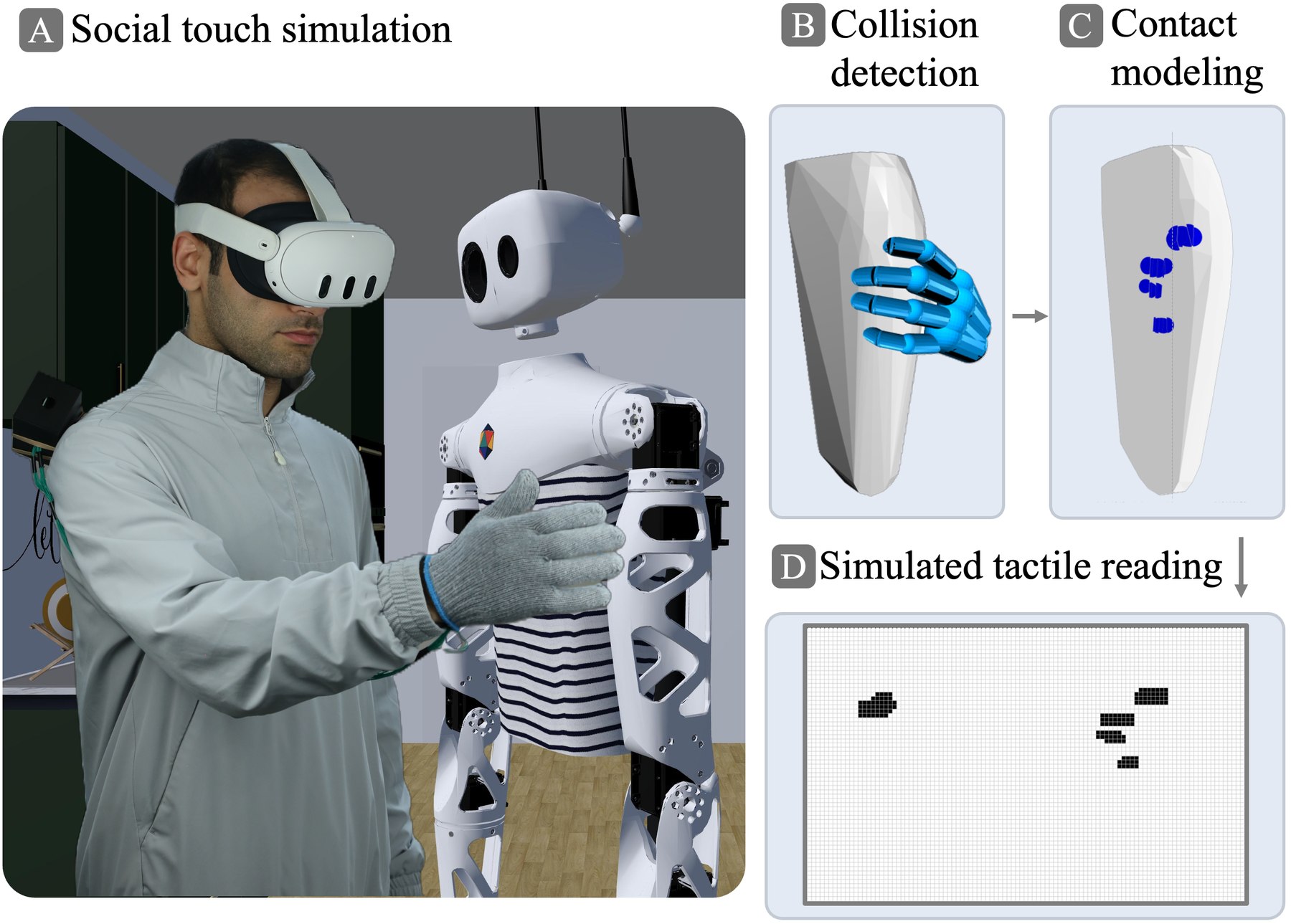
Tactile sensing for social-physical human–robot interaction (spHRI) is designed in a hardware-driven manner, where predefined sensor configurations constrain coverage, spatial resolution, and the range of recognizable gestures. We propose a requirement-driven framework that derives sensing requirements directly from interaction data. Using a VR-based platform with haptic feedback, we collected high-resolution whole-body contact distributions across multiple social scenarios, from which we identified nine recurring social touch gestures. Eight gestures were selected for controlled data collection with 18 participants, yielding an open-source dataset of 5,520 trials. Analysis of contact distributions and simulated tactile encodings provides quantitative baselines for skin coverage and sensor density on a humanoid robot platform. While demonstrated on a single robot platform, the methodology is designed to be transferable to other robot morphologies, potentially enabling morphology-specific sensing requirements to be derived prior to hardware fabrication.
Virtual Platform
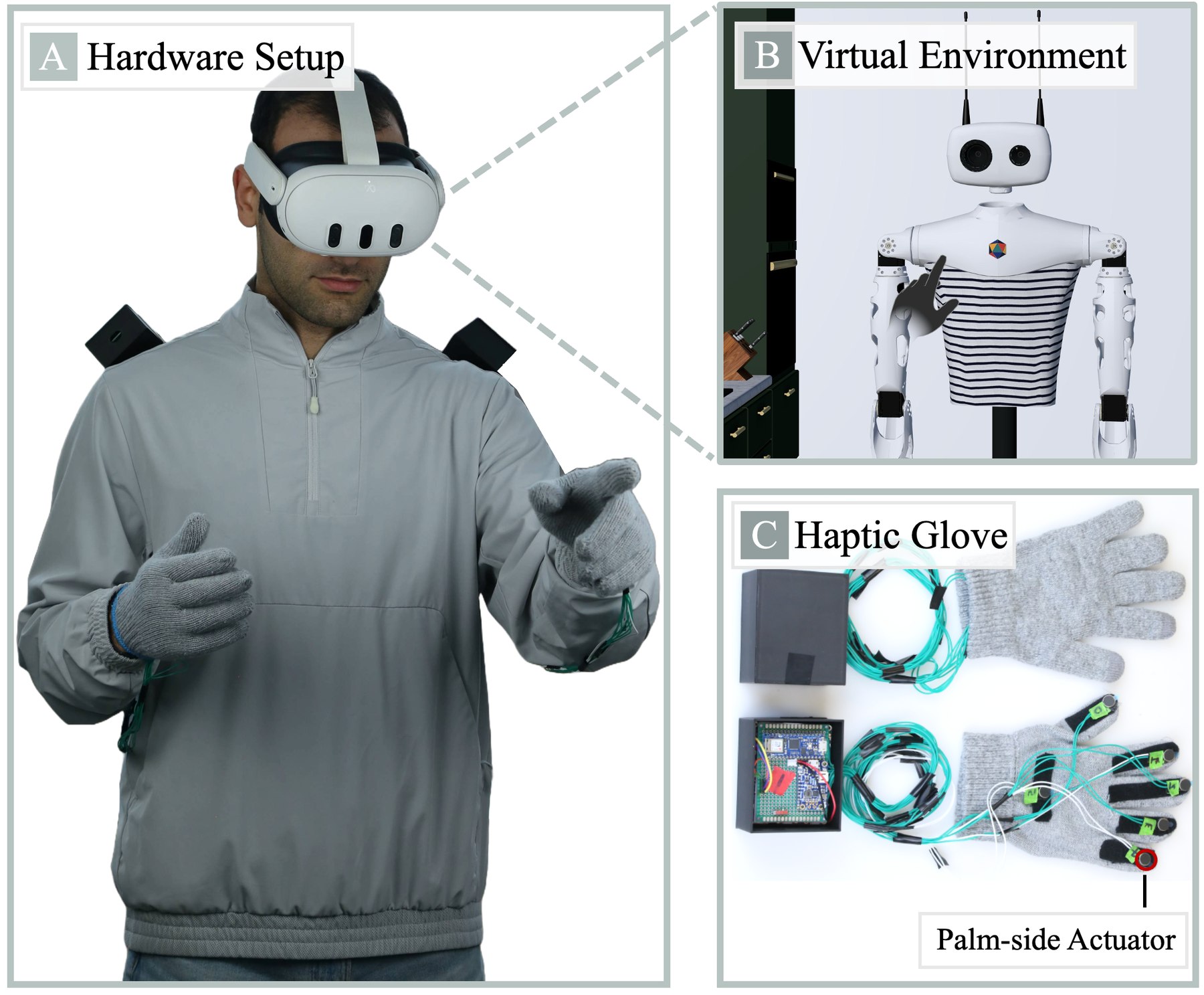
Participants wear a Meta Quest 3 headset for hand tracking (~30 Hz, OpenXR) and custom haptic gloves that pulse on contact with the virtual Reachy robot. The virtual environment was created in Unity; hand segments are approximated as spheres and checked against the robot's triangle mesh. To simulate a tactile sensor, the robot's arm mesh is fit to a cylindrical, and every contact patch is rasterized onto it.
Where Do People Touch a Robot?
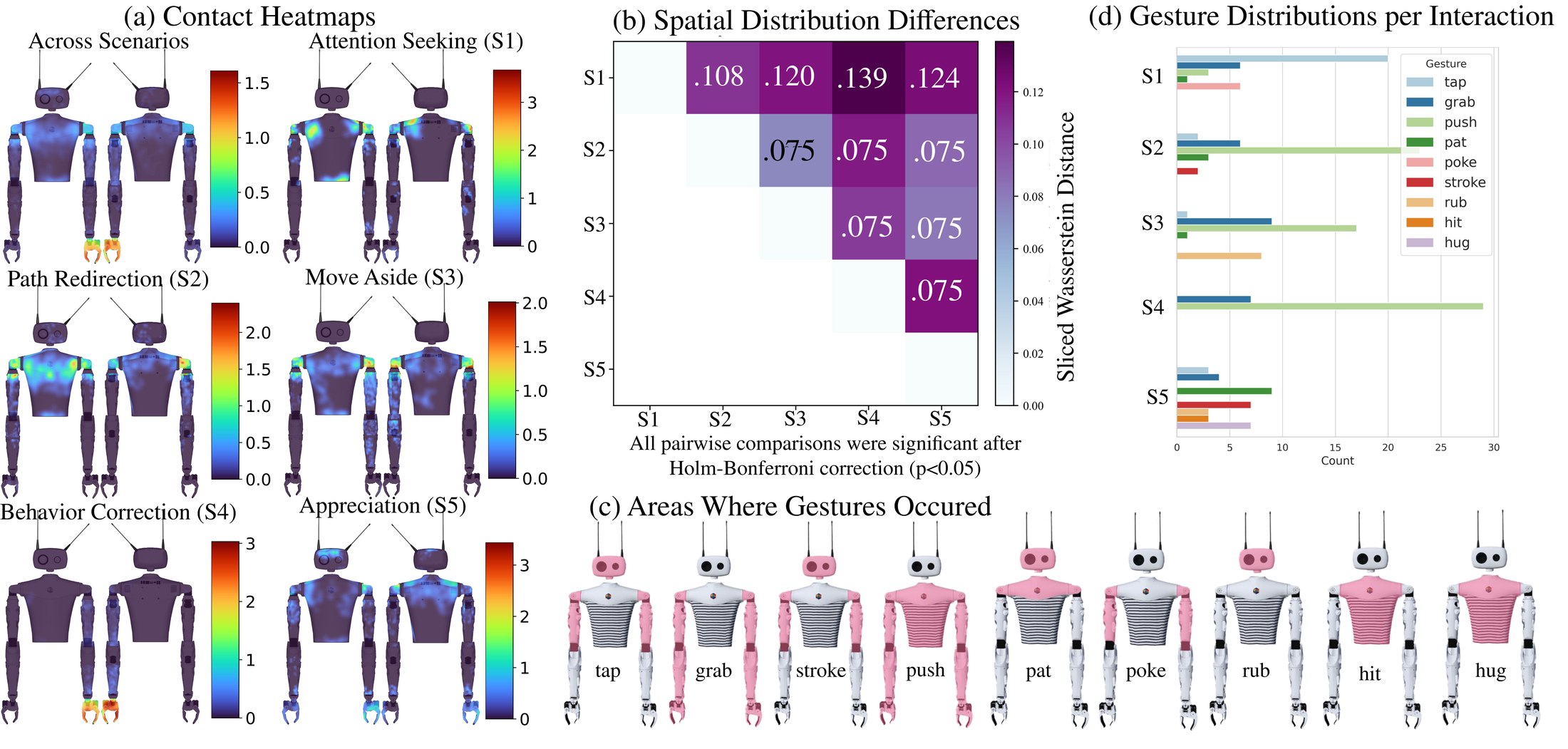
Twelve participants freely used touch in five predfined social interactions to the Reachy robot, getting attention, path redirection, moving aside, correct a sorting mistake, and show appreciation, without any imposed gesture vocabulary or sensor constraints.
← swipe figure →
Contact frequency maps built from this study show where touched occured for each scenario. The gestures that people used were coded.
Eight Gestures, Replayed and Simulated
Of the nine recurring gestures, eight were selected for controlled data collection — each replayed here as the tracked hand & robot mesh (left) alongside its resulting simulated tactile reading (right).
How Much Resolution Is Enough?
Replaying each trial at 50 different simulated sensor resolutions lets us measure exactly where classification accuracy saturates. Below, the same contact event (the “rub” gesture above) is carried through the full pipeline and re-encoded live at three grid resolutions:
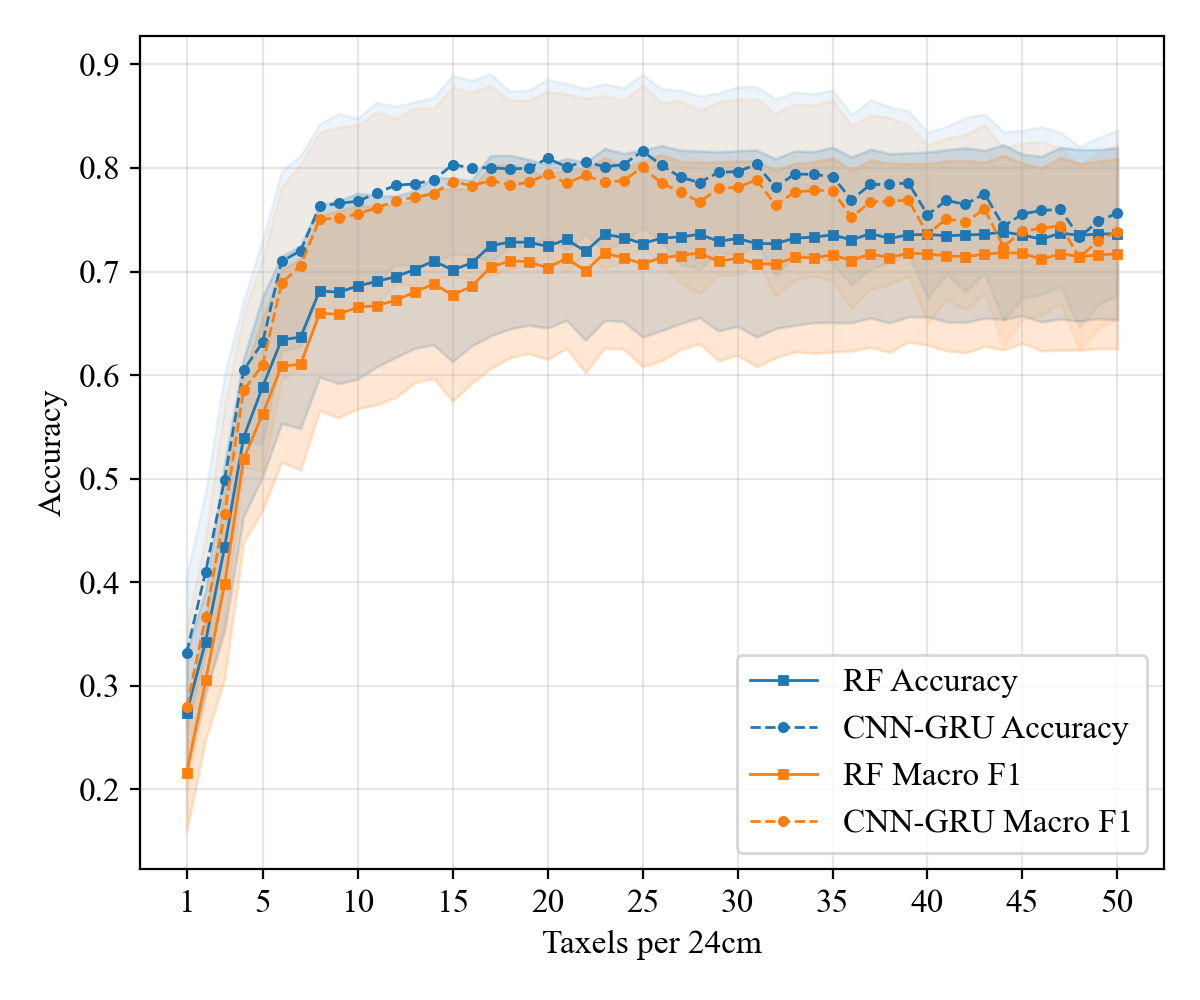
Both a Random Forest on hand-crafted features and a CNN–GRU on raw tactile frames follow the same pattern: accuracy climbs sharply below 8 taxels per 24 cm, then saturates around 18 taxels per 24 cm (≈ 1.3 cm² per taxel). Resolutions coarser than 4.8 cm² per taxel degrade recognition substantially — a concrete, quantitative target for tactile skin density on the Reachy arm, derived before any hardware was built.
VR Gesture Dataset
We release the full 5,600-trial dataset: per-frame 6-DoF hand joint and robot mesh poses for 18 participants performing 8 social touch gestures on both the arm and torso of a humanoid robot, along with the processing pipeline used to re-encode contact at arbitrary tactile resolutions.
BibTeX
@INPROCEEDINGS{crowder2026requirement,
  author={Crowder, Dakarai and Zhang, Ruohan and Block, Alexis E. and Yuan, Wenzhen},
  booktitle={2026 IEEE/RSJ International Conference on Intelligent Robots and Systems (IROS)},
  title={Requirement-Driven Design of Whole-Body Social Tactile Sensing via Virtual Human-Robot Interaction},
  year={2026}
}